light gazing, ışığa bakmak

Showing posts with label Plath. Show all posts

Friday, October 17, 2014

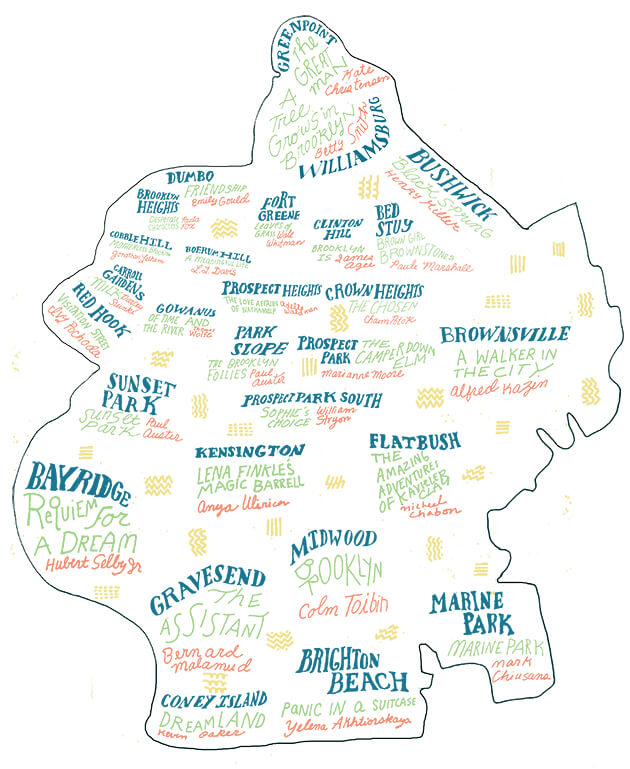
mapping the hood

from here.

from here.

and what a reading list, omg. as i understand it, the choice of books is purely illogical and unrelated to market or other weird values, and because of that, it is instantly wonderful. thumbs up.

(funny ohboy they think like me kind of moment: "but those maps tend to signify the fame level of the books rather than their literary merit; they also tend to be dominated by white men, most of them dead.")

strange choices: Washington and Sherman Alexie, Massachusets and the Bell Jar.


Saturday, January 7, 2012

cloughs

Blackberrying
S. Plath

Nobody in the lane, and nothing, nothing but blackberries,
Blackberries on either side, though on the right mainly,
A blackberry alley, going down in hooks, and a sea
Somewhere at the end of it, heaving. Blackberries
Big as the ball of my thumb, and dumb as eyes
Ebon in the hedges, fat
With blue-red juices. These they squander on my fingers.
I had not asked for such a blood sisterhood; they must love me.
They accommodate themselves to my milkbottle, flattening their sides.

Overhead go the choughs in black, cacophonous flocks—
Bits of burnt paper wheeling in a blown sky.
Theirs is the only voice, protesting, protesting.
I do not think the sea will appear at all.
The high, green meadows are glowing, as if lit from within.
I come to one bush of berries so ripe it is a bush of flies,
Hanging their bluegreen bellies and their wing panes in a Chinese screen.
The honey-feast of the berries has stunned them; they believe in heaven.
One more hook, and the berries and bushes end.

The only thing to come now is the sea.
From between two hills a sudden wind funnels at me,
Slapping its phantom laundry in my face.
These hills are too green and sweet to have tasted salt.
I follow the sheep path between them. A last hook brings me
To the hills’ northern face, and the face is orange rock
That looks out on nothing, nothing but a great space
Of white and pewter lights, and a din like silversmiths
Beating and beating at an intractable metal.

- -


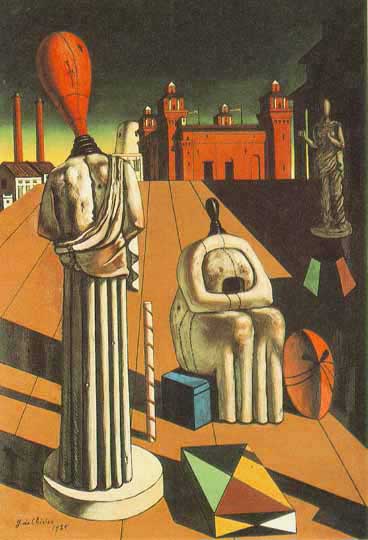
de onde "but the most remarkable technique is her method of replacing the spacial dimension in the pictorial plane with the temporal dimension of her life history", não a propósito deste mas de Disquieting Muses. mas enfim, afinal era este também. se virmos-


sabia que tinha já visto esta paisagem e o descer por um caminho no campo, em que há blackberries, até ao mar -verde metálico em Plath, que faz na paisagem o que faz a Chirico, uma projecção do que quer dizer (podia dizer do que sentia, mas não sei o que sentia). a vista segue por esse caminho, como no cinema, em moving image, e a beleza que é fazê-lo em palavras. (lembrando projecções, sempre: Meshes of the Day)

Friday, January 6, 2012

5.

Magnolia Shoals
Sylvia Plath

Up here among the gull cries
we stroll through a maze of pale
red-mottled relics, shells, claws

as if it were summer still.
That season has turned its back.
Through the green sea gardens stall,

bow, and recover their look
of the imperishable
gardens in an antique book

or tapestries on a wall,
leaves behind us warp and lapse.
The late month withers, as well.

Below us a white gull keeps
the weed-slicked shelf for his own,
hustles other gulls off. Crabs

rove over his field of stone;
mussels cluster blue as grapes :
his beak brings the harvest in.

The watercolorist grips
his brush in the stringent air.
The horizon's bare of ships,

the beach and the rocks are bare.
He paints a blizzard of gulls,
wings drumming in the winter.

4.


Two Views of a Cadaver Room
Sylvia Plath

(1)
The day she visited the dissecting room
They had four men laid out, black as burnt turkey,
Already half unstrung. A vinegary fume
Of the death vats clung to them;
The white-smocked boys started working.
The head of his cadaver had caved in,
And she could scarcely make out anything In that rubble of skull plates and old leather.
A sallow piece of string held it together. In their jars the snail-nosed babies moon and glow.
He hands her the cut-out heart like a cracked heirloom.
(2)
In Brueghel’s panorama of smoke and slaughter
Two people only are blind to the carrion army:
He, afloat in the sea of her blue satin
Skirts, sings in the direction Of her bare shoulder, while she bends,
Finger a leaflet of music, over him, Both of them deaf to the fiddle in the hands
Of the death’s-head shadowing their song.
These Flemish lovers flourish; not for long.
Yet desolation, stalled in paint, spares the little country
Foolish, delicate, in the lower right hand corner.

- - -

sylvia's color --should-I-say-colour

Thursday, January 5, 2012

s/n


Self-Portrait in Pastel
Sylvia Plath
1951

Wednesday, January 4, 2012

To Eva Descending the Stair
Sylvia Plath

Clocks cry: stillness is a lie, my dear;
The wheels revolve, the universe keeps running.
(Proud you halt upon the spiral stair.)

The asteroids turn traitor in the air,
And planets plot with old elliptic cunning;
Clocks cry: stillness is a lie, my dear.

Red the unraveled rose sings in your hair:
Blood springs eternal if the heart be burning.
(Proud you halt upon the spiral stair.)

Cryptic stars wind up the atmosphere,
In solar schemes the titled suns go turning;
Clocks cry: stillness is a lie, my dear.

Loud the immortal nightingales declare:
Love flames forever if the flesh be yearning.
(Proud you halt upon the spiral stair.)

Circling zodiac compels the year.
Intolerant beauty never will be learning.
Clocks cry: stillness is a lie, my dear.
(Proud you halt upon the spiral stair.)

visual poetics

Monday, January 2, 2012

3.


Chirico (1910), The Enigma of the Oracle


On the Decline of Oracles
Sylvia Plath

My father kept a vaulted conch
By two bronze bookends of ships in sail,
And as I listened its cold teeth seethed
With voices of that ambiguous sea
Old Bocklin missed, who held a shell
To hear the sea he could not hear.
What the seashell spoke to his inner ear
He knew, but no peasants know.

My father died, and when he died
He willed his books and shell away.
The books burned up, sea took the shell,
But I, I keep the voices he
Set in my ear, and in my eye
The sight of those blue, unseen waves
For which the ghost of Bocklin grieves.
The peasants feast and multiply.

Eclipsing the spitted ox I see
Neither brazen swan nor burning star,
Heraldry of a starker age,
But three men entering the yard,
And those men coming up the stair.
Profitless, their gossiping images
Invade the cloistral eye like pages
From a gross comic strip, and toward

The happening of this happening
The earth turns now. In half an hour
I shall go down the shabby stair and meet,
Coming up, those three. Worth
Less than present, past--this future.
Worthless such vision to eyes gone dull
That once descried Troy's towers fall,
Saw evil break out of the north.

- - -

2.

Chirico (1918)

The Disquieting Muses
Sylvia Plath

Mother, mother, what illbred aunt
Or what disfigured and unsightly
Cousin did you so unwisely keep
Unasked to my christening, that she
Sent these ladies in her stead
With heads like darning-eggs to nod
And nod and nod at foot and head
And at the left side of my crib?

Mother, who made to order stories
Of Mixie Blackshort the heroic bear,
Mother, whose witches always, always,
Got baked into gingerbread, I wonder
Whether you saw them, whether you said
Words to rid me of those three ladies
Nodding by night around my bed,
Mouthless, eyeless, with stitched bald head.

In the hurricane, when father's twelve
Study windows bellied in
Like bubbles about to break, you fed
My brother and me cookies and Ovaltine
And helped the two of us to choir:
"Thor is angry: boom boom boom!
Thor is angry: we don't care!"
But those ladies broke the panes.

When on tiptoe the schoolgirls danced,
Blinking flashlights like fireflies
And singing the glowworm song, I could
Not lift a foot in the twinkle-dress
But, heavy-footed, stood aside
In the shadow cast by my dismal-headed
Godmothers, and you cried and cried:
And the shadow stretched, the lights went out.

Mother, you sent me to piano lessons
And praised my arabesques and trills
Although each teacher found my touch
Oddly wooden in spite of scales
And the hours of practicing, my ear
Tone-deaf and yes, unteachable.
I learned, I learned, I learned elsewhere,
From muses unhired by you, dear mother,

I woke one day to see you, mother,
Floating above me in bluest air
On a green balloon bright with a million
Flowers and bluebirds that never were
Never, never, found anywhere.
But the little planet bobbed away
Like a soap-bubble as you called: Come here!
And I faced my traveling companions.

Day now, night now, at head, side, feet,
They stand their vigil in gowns of stone,
Faces blank as the day I was born,
Their shadows long in the setting sun
That never brightens or goes down.
And this is the kingdom you bore me to,
Mother, mother. But no frown of mine
Will betray the company I keep.

- - -
1.

Chirico (1927)

Conversation Among the Ruins
Sylvia Plath

Through portico of my elegant house you stalk
With your wild furies, disturbing garlands of fruit
And the fabulous lutes and peacocks, rending the net
Of all decorum which holds the whirlwind back.
Now, rich order of walls is fallen; rooks croak
Above the appalling ruin; in bleak light
Of your stormy eye, magic takes flight
Like a daunted witch, quitting castle when real days break.

Fractured pillars frame prospects of rock;
While you stand heroic in coat and tie, I sit
Composed in Grecian tunic and psyche-knot,
Rooted to your black look, the play turned tragic:
Which such blight wrought on our bankrupt estate,
What ceremony of words can patch the havoc?

Tuesday, November 22, 2011

Sylvia Plath's Drawings

agora à venda na The Mayor Gallery, à excepção de um retrato de Ted Hughes. a colecção esteve, até agora, na posse da filha, Frieda Hughes. para além de vir a ficar dispersa, esta colecção choca pelo contraste imagem-texto.


- -
"Sylvia Plath: Her Drawings

Plath’s extraordinary dedication to her writing can be connected to her particular ability to see things with a honed artistic eye, and her quest to accurately record this visual stimulus in a perfect form of prose. When the drawings are shown together, the viewer gets a strong sense of her story, focused eye and fastidious nature.

Students of Plath will pick up on the visual clues, which point to passages in her writing. Once such example is a drawing entitled “The Bell Jar’ which is also the title of her most famous written work. It is a sensitive image of a pair of shoes, which have apparently been discarded, and brings to mind the scene in Chapter 12 of the Bell Jar, which reads ‘I had removed my patent leather shoes after a while, for they foundered badly in the sand. It pleased me to think they would be perched there on a silver log pointing out to sea, like a sort of soul-compass after I was dead”.

Sylvia Plath’s younger student years at Smith were divided equally between her love of fine art and literature. Later when she arrived in Cambridge, her writing began to take precedence over her artwork and she developed her identity as a writer, though sketching still held great appeal for her. Drawing seemed to help her to focus her busy mind. She saw it as a stimulating and enjoyable leisure activity, though she tended not to draw from memory, often arranging household domestic objects as challenging still-lifes. Ted Hughes observed that nothing refreshed her more than sitting in front of an intricate pile of objects for hours, laboriously delineating each item.

She seemed to be drawn to refining her skills by sketching objects from the natural word, such as contented cows grazing in a field, meadow flowers, fruit, and sensual looking conkers and nuts. She also liked to make diligent studies of objects that interested her in the museums and architectural sites she visited on her travels.

During her two years at Cambridge, she sketched quite mundane local scenes, and individual objects and people. Her images of buildings are more atmospheric and seem to reflect her thinking processes. One such is a drawing that she herself mentioned as a fine example. It shows a quintessential winter’s day in Cambridge with a row of picturesque white cottages whose chimneys bellow hot smoke into the sky. One cannot help but feel Plath’s desire to escape the cold day and find comfort in one of the warm, inviting, little cottages. Perhaps the most haunting image in the show is ‘Wuthering Heights’. A derelict building in a state of disrepair is set against a sinister looking, jagged tree its roof falling apart, open to the elements.

For Plath this was also a period of exploration and independence. In the spring break of 1955, she made a journey with her first love Richard Sassoon by train from Paris to Nice. She hoped to meet him again in 1956 but ended up seeing the city alone. Her journals recount her walking five to ten miles every day and spending her afternoons sketching the city.

Her journal for 16 March 1956 reads: “Then, inspired, I took my sketch book and squatted in the sun at the very end of the Ile de la Cite in a little green park of Henri 4 du Vert Galant & began to draw the vista through the Pont Neuf; it was a good composition with the arches of the bridge framing trees & another bridge, and I was aware of people standing all around watching but I didn’t look at them - just hummed & went on sketching. It was not very good, too unsure & messily shaded, but I think I will do line drawings from now on in the easy style of Matisse. Felt I knew that view though, through the fiber of my hand”.

The show also features other Parisian mementos. She sketched restaurant interiors, bottles of wine, the roofs and chimney tops of Paris, a tabac, a colourful kiosk and the lemonade stand in the Tuileries.

Plath reserved her more ambitious ink drawings to accompany published essays, which appeared in Cambridge Vista, Varsity and The Christian Science Monitor. To this effect, a 1959 essay in Christian Science Monitor entitled ‘Explorations Lead to Interesting Discoveries’ shows one of her most complex drawings in the show, illustrating what she calls ‘ A colourful pattern of rounds and oblongs, knobs and wheels, legs and handles’. The accompanying narrative describes her delight at discovering, whilst walking in the country, an abandoned garage, overgrown with grass and weeds, strange objects piled up and jumbled together outside it.

She had also published “Mosaics - an afternoon of discovery”, in the same journal, an article with a sketch about the Spanish fishing village Benidorm, where she had spent her honeymoon with Ted Hughes. In 1958, Plath wrote “Wait till you see these of Benidorm - the best I’ve ever done in my life, very heavily stylized shading and lines: very difficult subjects too - the peasant market, a composition of three sardine boats on a bay with their elaborate lights, and a good one of the cliff – headland with the houses over the sea. I’m going to write an article for them and send them to the Monitor. I feel I’m developing a kind of primitive style of my own which I am very fond of. Wait till you see - the Cambridge sketch was nothing compared to these”.
- -

O texto daqui, a página da exposição.

Friday, June 17, 2011

s/n


Two Views of a Cadaver Room
Sylvia Plath

I

The day she visited the dissecting room
They had four men laid out, black as burnt turkey,
Already half-unstrung. A vinegary fume
Of the death vats clung to them;
The white-smocked boys started working.
The head of his cadaver had caved in,
And she could scarcely make out anything
In that rubble of skull plates and old leather.
A sallow piece of string held it together.
In their jars the snail-nosed babies moon and glow.
He hands her the cut-out heart like a cracked heirloom.

II

In Brueghel’s panorama of smoke and slaughter
Two people only are blind to the carrion army:
He, afloat in the sea of her blue satin
Skirts, sings in the direction
Of her bare shoulder, while she bends,
Fingering a leaflet of music, over him,
Both of them deaf to the fiddle in the hands
Of the death’s-head shadowing their song.
These Flemish lovers flourish; not for long.

Yet desolation, stalled in paint, spares the little country
Foolish, delicate, in the lower right hand corner.

- - -

talvez, talvez quem sabe, antecipando o próximo ano.

 
Share