light gazing, ışığa bakmak

Showing posts with label Updike. Show all posts

Wednesday, May 15, 2013

Updike, eat my dust (3)

"I've painted everything, absolutely everything: Our Prophet at the mosque before the green prayer niche seated together with his four caliphs; in another book, the Apostle and Prophet of God ascending the seven heavens on the night of the Ascension; Alexander on his way to China banging on the drum of a seaside temple to scare off a monster stirring up the ocean with storms; a masturbating sultan spying on the beauties of his harem swimming naked in his pool while listening to a lute; a young wrestler sure of victory after learning all his mentor's moves, only to be defeated in the presence of the Sultan at the hands of his mentor who had yet one last trick up his sleeve; Leyla and Mejnun as children kneeling in a schoolroom with exquisitely decorated walls, falling in love while reciting the Glorious Koran; the inability of lovers, from the most embarrassed to the most crass, to look at each other; the stone by stone construction of palaces; the punishment by torture of the guilty; the flight of eagles; playful rabbits; treacherous tigers; cypress and plane trees that held magpies; Death; competing poets; feasts to commemorate victory; and men like you who see nothing but the soup before them."

Pamuk, ainda no cap. 46 de My Name is Red.

outro capítulo glorioso e ainda mais por ser o assassino quem fala, num momento em que num mágico bater de pestanas, milisegundos, o leitor vê em negativo subitamente e simpatiza com o assassino. aqui também, os temas sacrossantos (estava a brincar) de Pamuk: realidade, imagem e texto. a última frase do parágrafo anterior concentra [uma multidão a caber num mini] as três caras visíveis: eat them all, the blank page of the writer, the empty paper before the artist.

intervir na realidade e no texto é a marca de Pamuk, com a intensidade de uma paixão metódica e rancorosa, por vezes, exultante, por outras. sem paixão não seria possível reunir quatro mil beatas de cigarros, catalogá-las e expô-las numa instalação plena de sentido, paralela a um capítulo de um livro. as quatro mil beatas pertencem tanto ao Museu da Inocência como poderiam estar no Palais de Tokyo, onde artistas que geralmente não invadem esse outro campo da expressão, instalam colecções de objectos muito semelhantes. lembro-me de Family Stuff.
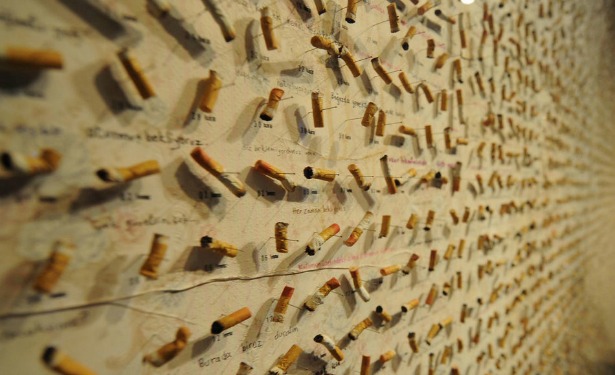

(imagem daqui)


no parágrafo acima, o assassino fala como se ele próprio fosse Bihzad, o mestre há muito desaparecido, o que não é inocente: o iluminista passou a sua vida, tal como os outros, a copiar Bihzad, e sabe todas as suas obras de cor. aliás, Kamāl ud-Dīn Behzād.
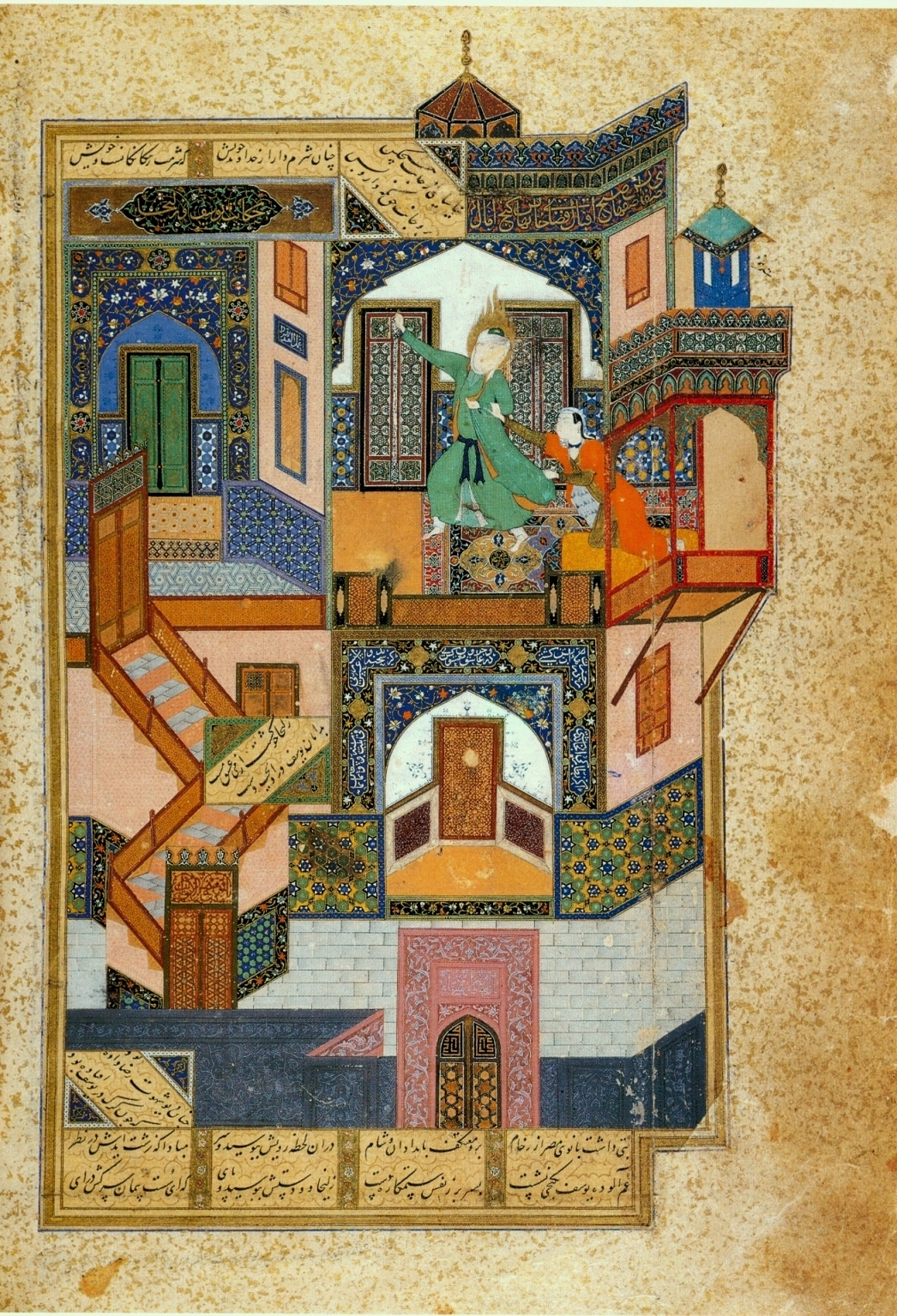


de Herat e Tabriz.

Updike, eat my dust (2)

"I wandered through the Chicken-Sellers Market in Bayazid, through the empty square of the slave market, amid the pleasant aromas of soup and pudding shops, as if searching. I passed the closed doors of barbershops, clothes pressers, an old bread baker who was counting his money and looking at me in surprise; I passed a grocer's shop smelling of pickles and salted fish, and since my eyes were taken only by colors, I walked into a herbs and notions shop where something was being weighed, and in the light of a lamp, stared passionately, the way one looks at one's beloved, at the sacks of coffee, ginger, saffron and cinnamon, the colorful cans of gum mastic, the aniseed whose scent wafted from the counter, and at mounds of brown and black cumin. Sometimes I want to put everything into my mouth; sometimes I want to fill a page with a picture of all creation."
Pamuk no capítulo 46 de My Name is Red.

Friday, May 3, 2013

portraiture

getting to know an author so closely can be, at times, a bit unsettling. assim foi ler o capítulo sexto. quanto a Updike, e apesar de só o ter feito com uma autora mais do que menor (Laura Grimaldi), vou bani-lo da prateleira. detalhes. sobre Pamuk, imagino, posso falar durante muitas horas e podia escrever páginas e páginas. tal como no início, penso que escreve sempre o mesmo livro. não sei se não serão assim todos os autores.

para o que interessa, uma perspectiva do que é um retrato:

"When I first laid eyes on her child, I knew at once what I’d long and mistakenly recalled about Shekure’s face. Like Orhan’s face, hers was thin, though her chin was longer than what I remembered. So, then the mouth of my beloved was surely smaller and narrower than I imagined it to be. For a dozen years, as I ventured from city to city, I’d widened Shekure’s mouth out of desire and had imagined her lips to be more pert, fleshy and irresistible, like a large, shiny cherry.

Had I taken Shekure's portrait with me, rendered in the style of the Venetian masters, I wouldn't have felt such loss during my long travels when I could scarcely remember my beloved, whose face I'd left somewhere behind me. For if a lover's face survives emblazoned on your heart, the world is still your home."

Pamuk em My Name is Red.


Thursday, May 2, 2013

shame on Updike

a xenofobia literária parece ser uma coisa inacreditável e no entanto lá está ela. porque somos tão crédulos, porque acreditamos no que está escrito, nos canons, nos opinion makers, nos dinosauros do jornalismo. acreditamos porque não sabemos e partimos do princípio que outros sabem melhor. enganar, desviar, adulterar, manipular. pensar pela sua cabeça e ver com os seus próprios olhos, luxos da vida contemporânea.

abaixo, parte da crítica a My Name is Red a que dei cores: todas as palavras que ou não são verdade ou são indicativas de desprezo, palavras que desejam apequenar ou humilhar. shame on Updike, sobre quem Bloom disse The American sublime will never touch his pages. (um pouco da sua própria aspirina)

no NY Times:


Orhan Pamuk is a fifty-year-old Turk frequently hailed as his country's foremost novelist. He is both avant-garde and best-selling. His eminence, like that of the Albanian Ismail Kadare, looms singularly; Western culture-consumers, it may be, don't expect Turkey and Albania to produce novelists at all—at least, novelists so wise in the ways of modernism and postmodernism. Pamuk, the grandson of a wealthy factory director and railroad builder, has been privileged to write without needing to make a living by it. From a family of engineers, he studied engineering, architecture, and journalism, and practiced none of them. Until the age of thirty, he lived with his parents, writing novels that did not get published. When literary success dawned, he married, and now, living in Istanbul with his wife and daughter, he composes, according to an interview he gave Publishers Weekly in 1994, from eleven at night till four in the morning and again, after arising at noon, from two in the afternoon till eight. The results have been prodigious: six novels that recapitulate in Turkish the twentieth-century novel's major modes. His first, "Cevdet Bey and His Sons," was likened to Thomas Mann's "Buddenbrooks"; his next, "The Silent House," a multiply narrated week of family interaction, suggested to critics Virginia Woolf and William Faulkner; his third, "The White Castle," a creepy seventeenth-century tale of double identity, evoked comparison to Borges and Calvino; the fourth, "The Black Book," a missing-persons adventure saturated in details of Istanbul, was written, by Pamuk's own admission, with Joyce's "Ulysses" in mind; the fifth, "The New Life," a dreamlike first-person contemporary tale, was described by a reviewer as "Kafka with a light touch"; and the sixth, "My Name Is Red" (translated from the Turkish by Erdag Göknar; Knopf; $25.95), a murder mystery set in sixteenth-century Istanbul, uses the art of miniature illumination, much as Mann's "Doctor Faustus" did music, to explore a nation's soul.

"My Name Is Red" weighs in, with its appended chronology, at more than four hundred big pages and belongs, in its high color and scholarly density, with other recent novels that load extensive book learning onto a detective-story plot: A. S. Byatt's "Possession" and Umberto Eco's "The Name of the Rose" and "Foucault's Pendulum." One worries, with such ambitious flights, whether they aren't a bit narrow-shouldered for the task—whether the rather ironically melodramatic story can carry its burden of pedantry and large import. Nineteenth-century novelists catered to a more generous, less nibbled attention span; they breathed with bigger lungs and naturally wrote long, deep, and wide. Although Pamuk demonstrates the patience and constructive ability of the nineteenth-century fabricators and their heirs Proust and Mann, his instinctive affinity lies with the relatively short-winded Calvino and Borges, philosophical artificers of boxes within boxes. Pamuk's boxes are bigger, but the toylike feeling persists, of craftsmanship exulting in its powers, of giant gadgets like those with which the Europeans used to woo Turkey's sultan with evidence of Western technology.

(...)

Pamuk's consciousness of Turkey's fate of imitation and inauthenticity (...)

In the proud fashion of Joyce finishing "Ulysses," Pamuk has dated "My Name Is Red" at the end: "1990-92, 1994-98." The novel bears traces of an interrupted composition, wherein the author had to get a fresh grip upon the many glittering threads of theory and incident. Orhan Pamuk's labor, in this otherworld of miniatures, was long, and the reader's labor at times feels long, between spells of being entranced and educated.

(...)

Translating from the Turkish, a non-Indo-European language with a grammar that puts the verb at the end of even the longest sentence, isn't a task for everybody; Erdag Göknar deserves praise for the cool, smooth English in which he has rendered Pamuk's finespun sentences, passionate art appreciations, slyly pedantic debates, eerie urban scenes (it keeps snowing, which one doesn't think of as Istanbul weather), and exhaustive inventories.

mais não vale a pena, nem ler nem pensar nisso.

- -
em inglês, fazendo esquecer os Updikes, ver aqui.
e como se escreve uma crítica, mesmo que americana, a do Chicago Tribune.


Wednesday, March 6, 2013

sometimes

'Sometimes' is an astounding chapter that made me go back to the pale Updikes of daily life. between boredom and desire, death and birth, being thankful and oblivious, such is the difference between a new but now old country and an ancient but renewed one. lives are lived so differently, I many times wonder whether we have any choice.

"Sometimes there'd be a power outage and we could see our cigarette embers in the dark."
Pamuk in The Museum of Innocence.


--
most impressive is the fact that the Keskin's living room remind me of my own living room, my own family dinners as a child, the same way we would sit watching tv, the same way we would welcome a special treat, how we would listen to thunder. Pamuk recognizes that not only has he become the voice of his country, but also the voice of a generation worlwide, both of which he doesn't want.


Share