
Showing posts with label lit e arte. Show all posts
Showing posts with label lit e arte. Show all posts
Tuesday, October 13, 2015

Sunday, February 1, 2015
jardins
"Mon volume est un tableau. Il est vrai qu'un tableau est forcément vu, si grand qu'il soit, tandis qu'un livre ne se lit pas de la même manière” (My volume is a picture. It's true that a picture is necessarily seen, however large it is, whereas a book isn't read in the same way.)
Proust numa carta a Jean Cocteau, e referido por Pamuk em The Naïve and The Sentimental Novelist.
por estranho que possa parecer os meus melhores professores foram Feijó e Pamuk. com eles aprendi tudo. o melhor practitioner, esse é Tolstoi (para mim, como tudo). há Proust e depois há o resto do mundo. parece-me tão incompleto falar de ekphrasis recorrendo só à literatura anglófila. parece-me que o francês foi sempre mais visual, mas que sei eu.
eu sabia que havia qualquer coisa diferente e especial nas madalenas. agora estou certa: madalenas e memória. (os cientistas são divertidos nos seus permanentes cortes daquilo que é inteiro para provarem uma certa 'ideia': fizeram-se experiências para ver se o odor era mais facilmente retido pela memória de que a visão e a teoria falhou; esquecem-se cheiros tão facilmente como se esquecem imagens. imagino que as preocupações psicológicas sejam patrocinadas por interesses publicitários sempre na procura de novos meios para chegar à consciência/inconsciência do pobre consumidor. usar uma teoria para vender, a triste realidade. separar aquilo que é uno, o trabalho da análise e da procura da verdade. talvez não exista verdade e talvez separar não seja o que é preciso para encontrar o que se deseja.) a literatura sabe mais sobre ser humano, sempre soube.
Wednesday, November 12, 2014
where is ana?

Tuesday, March 11, 2014
os jogadores de cartas (comer ao balcão)


confesso, estava morta por ler como a dupla Guerra tinha escrito o jogo de cartas. parece que bem, foi como se pusesse uns óculos com mais dioptrias. logo à saída da Pó dos Livros, nos bancos à sombra da conde de valbom.
o primeiro capítulo do jogo podeia estar entre um destes abaixo, especialmente de Caravaggio, se bem que tenhamos o resumo contextual moral do jogo: Rostov acabou de receber aquela quantia dos pais, para durar seis meses. a continuação do jogo no capítulo seguinte podia ter sido de Dostoievsky ou, sob um tema moralizante: a queda de um homem (pouco esperto), ou de um miúdo mimado. mas não tem este Caravaggio o mesmo contexto?

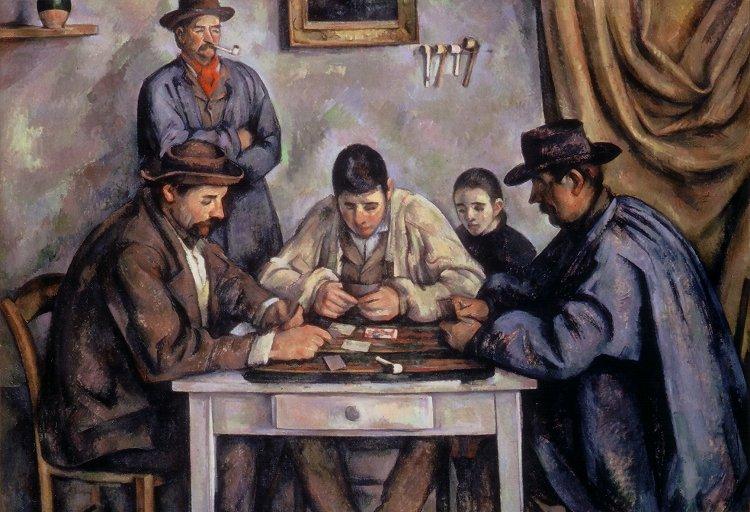


Viktor Vasnetsov
o nome do jogo é 'faro'.
(a propósito: existe alguma outra livraria que vá ao fim do mundo para encontrar um livro e que não desista nem mesmo depois de um ano? não sei, mas ainda não vi senão esta, a Pó dos Livros).
Tuesday, February 4, 2014
ʻAjāʼib al-makhlūqāt ou
as maravilhas da criação e outras estranhezas da existência, uma maravilhosa estranheza persa do século 16 oferecida aos meus(nossos) olhos pela biblioteca de Cambridge. (o que é um museu?).
fascinante e imperdível.
para ver também a colecção de manuscritos islâmicos.
e para os intrépidos aventureiros, todas prateleiras.
outro local de fascínio: Spanish chapbooks: 'A small sample of this fascinating popular literature from the eighteenth and nineteenth centuries.', cordel ibérico do mais exaltado. (por exemplo)
Thursday, January 23, 2014
second portrait (2) by the anti-ekphrastic writer
Passing through the dining-room, a room not very large, with dark panelled walls, Stepan Arkadyevitch and Levin walked over the soft carpet to the half-dark study, lighted up by a single lamp with a big dark shade. Another lamp with a reflector was hanging on the wall, lighting up a big full-length portrait of a woman, which Levin could not help looking at. It was the portrait of Anna, painted in Italy by Mihailov. While Stepan Arkadyevitch went behind the treillage, and the man’s voice which had been speaking paused, Levin gazed at the portrait, which stood out from the frame in the brilliant light thrown on it, and he could not tear himself away from it. He positively forgot where he was, and not even hearing what was said, he could not take his eyes off the marvellous portrait. It was not a picture, but a living, charming woman, with black curling hair, with bare arms and shoulders, with a pensive smile on the lips, covered with soft down; triumphantly and softly she looked at him with eyes that baffled him. She was not living only because she was more beautiful than a living woman can be. 16
‘I am delighted!’ He heard suddenly near him a voice, unmistakably addressing him, the voice of the very woman he had been admiring in the portrait. Anna had come from behind the treillage to meet him, and Levin saw in the dim light of the study the very woman of the portrait, in a dark blue shot gown, not in the same position nor with the same expression, but with the same perfection of beauty which the artist had caught in the portrait. She was less dazzling in reality, but, on the other hand, there was something fresh and seductive in the living woman which was not in the portrait.
no cap. 9 da parte 7.
In the entr’acte Levin and Pestsov fell into an argument upon the merits and defects of music of the Wagner school. Levin maintained that the mistake of Wagner and all his followers lay in their trying to take music into the sphere of another art, just as poetry goes wrong when it tries to paint a face as the art of painting ought to do, and as an instance of this mistake he cited the sculptor who carved in marble certain poetic phantasms flitting round the figure of the poet on the pedestal.
no cap. 5 da parte 7
não deixa de ser um faz o que eu digo mas não o que eu faço. ou dito de outra maneira:
"The power of the ekphrastic moments in Anna Karenina motivated John Bayley to draw the conclusion that Tolstoy's views on art 'are expressed more powerfully in the narration of Anna than in his theoretical statements on art.'" (daqui, interessantíssimo artigo)
Sunday, January 19, 2014
ceifa
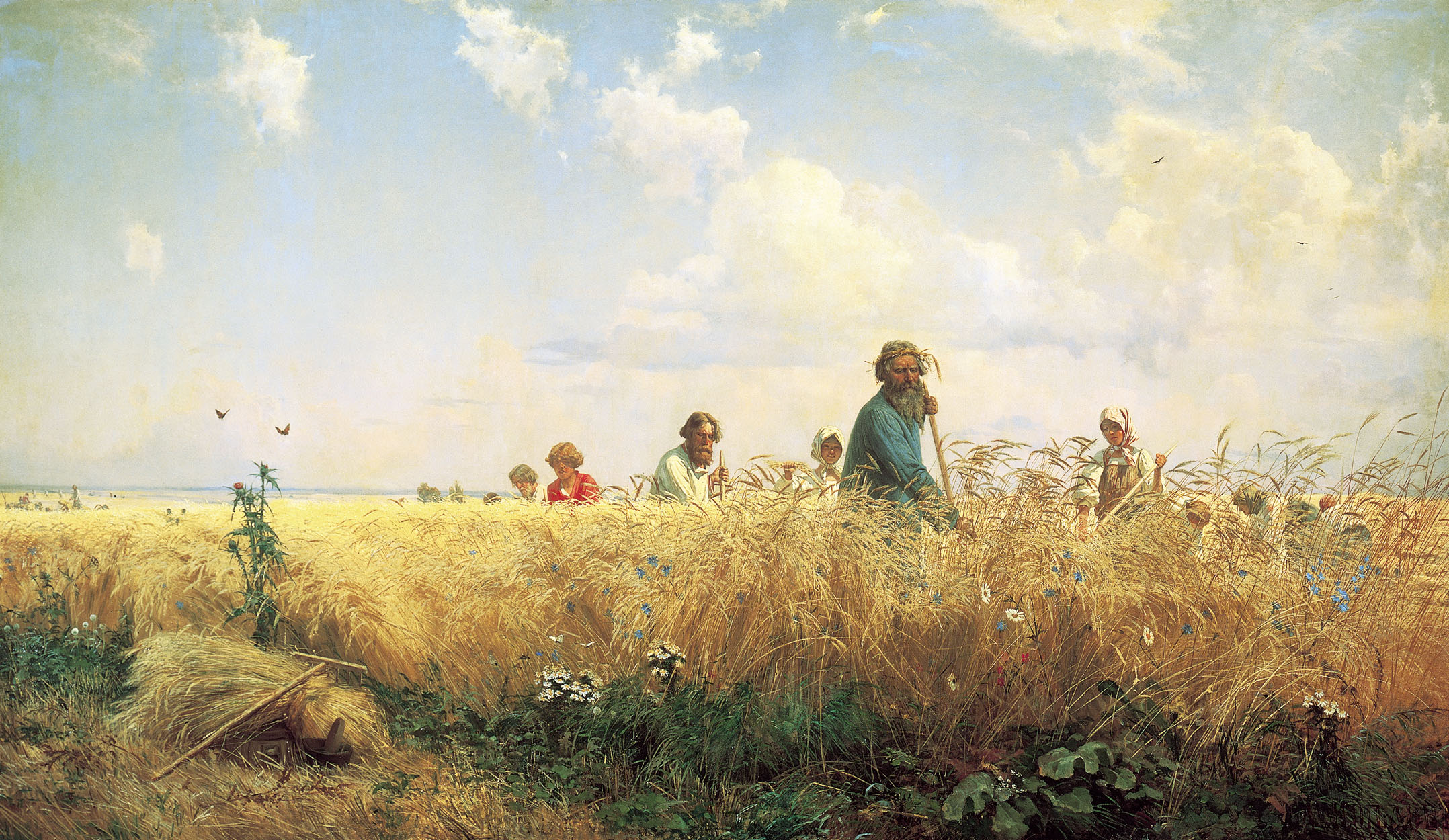
de Grigoriy Myasoyedov. os mujiques, em Tolstoi já depois das reformas agrícolas de 1861 (libertação dos mujiques enquanto servos), o grande tema dos proprietários rurais de então.

retrato
"Aleksei Aleksándrovitch mandou servir o chá no gabinete e, brincando com a faca maciça, dirigiu-se à poltrona junto à qual estava uma lâmpada preparada e um livro francês que começara a ler sobre inscrições antigas.
Por cima da poltrona estava pendurado, num caixilho dourado oval, o retrato de Anna, feito por um pintor célebre. Aleksei Aleksándrovitch olhou para o retrato. Os olhos impenetráveis olhavam para ele insolentes e trocistas, como naquela última noite da sua explicação. A visão da renda preta que lhe cobria a cabeça, dos cabelos negros e da bela mão branca com o dedo anelar coberto de anéis, tudo excelentemente executado pelo artista, teve em Aleksei Aleksándrovitch o efeito insuportável de uma insolência e de um desafio. Depois de olhar o retrato durante um minuto, estremeceu de tal modo que os seus lábios tremeram produzindo um som "brr" e ele desviou o olhar. Sentando-se precipitadamente na poltrona, abriu o livro."
Tolstoi em Anna Karénina.
e algumas obras de Pavel Fedotov, uns vinte anos antes de Anna e, neste caso, não propriamente retratos.


na verdade, e por mais estranho que pareça, não tenho simpatia por Anna.
Wednesday, January 15, 2014
retratos e paisagens (portrait and landscape in Tolstoy)
(...) Thus, Tolstoy appears to perpetuate the romantic tradition of elevating the category of the sublime over that of the beautiful and prefering the landscape to the portrait.", Amy Mandelker no excelente 'The Painted Lady: The Poetics of Ekphrasis." se bem que, no ponto em que me encontro - quando kitti passa por Lévin na sua chegada ao 'campo': estava mais capaz de colocar Tolstoi num cruzamento estranho entre Sebastião Salgado e Martin Parr, fora das categorias anteriores, mas retratista de situações em que uma multidão se junta como no baile, na corrida de cavalos e na ceifa, três episódios absolutamente inesquecíveis. o equivalente aos retratos de grupo dos pintores holandeses da época dourada.
não sei se Tolstoi leu A Cartuxa de Parma, 30 anos antes de Karénina, e a também inesquecível cena da guerra do início, mas-- ("Referring to his literary origins, Tolstoy mentions Stendhal as the writer to whom, apart from Rousseau, he was most indebted.") se calhar leu.

- -
para ler também: The architecture of Anna Karenina de Elisabeth Stenbock-Fermor, em particular o capítulo 'Writing and Rewriting'.
Sunday, September 15, 2013
museum
as cultural genocide: "it seemed from the museum's point of view we were never part of this country's history", Corey Flood para a Native Hoop Magazine que pode ser lida online aqui.
Wednesday, July 17, 2013
que Afonso Cruz me perdoe,
mas como é que eu podia passar sem citar este 'Jazz, Rosas e Andorinhas', especialmente esta: Isso não se faz com a literatura nem com a pintura. Uma pessoa não consegue fazer os corpos mexer com os girassóis de Van Gogh. tinha uma citação semelhante, por oposição, de Pamuk. a música, um elemento estranho na relação da ekphrasis. de certo modo, reflete o que senti ao ler guiões de ópera que eu, palavrodependente, queria coleccionar. colecção errada.


também gostei do 'nenhum tem a capacidade de o fazer como o senhor'. pois não.
Friday, July 5, 2013
'Words, Pictures, Objects' (2)
"I have said that the art of writing novels is the ability to perceive the thoughts and sensations of protagonists within a landscape — that is, amid the surrounding objects and images. This ability is less important in the art of some novelists, the best example being Dostoyevsky. Reading Dostoyevsky's novels, we sometimes feel that we have encountered something surprisingly profound —that we have attained a truly deep knowledge of life, of people, and above all of our own selves. This knowledge seems so familiar and at the same time so extraordinary, that it occasionally fills us with fear.
The knowledge or wisdom that Dostoyevsky provides us speaks not to our visual imagination, but to our verbal imagination. With regard to the power of the novel and an understanding of the human psyche, Tolstoy is sometimes equally profound; and because these two men wrote during the same period and within the same culture, they are invariably compared with each other. Yet the greater part of Tolstoy's insights are different in kind from Dostoyevsky's. Tolstoy addresses not just our verbal imagination, but—even more — our visual imagination.
No doubt every literary text addresses both our visual and textual intelligence. In live theater, where everything takes place in front of our eyes and for the pleasure of our eyes, wordplay, analytical thought, the joys of poetic language, and the flow of everyday speech are also, of course, part of the pleasure. In the case of an exceedingly dramatic writer like Dostoyevsky—say, in the suicide scene in The Devils—there may be no explicit image on the page (the reader has to imagine, along with the hero, someone committing suicide in the room next door), yet the scene leaves a strong visual impression on us. Still, despite all the tension that sets the reader's head spinning—or perhaps because of it— only a few objects, images, and scenes from Dostoyevsky's work actually stick in our mind. Whereas Tolstoy's world is teeming with suggestive, subtly placed objects, Dostoyevsky's rooms almost seem to be empty.
Allow me to generalize here, so that I can more easily explain my point. Some writers are better at addressing our verbal imagination, while others speak more powerfully to our visual imagination. I will call the first kind ‘verbal writers' and the second kind ‘visual writers'. Homer, for me, is a visual writer: as I read him, countless images pass before my eyes. I enjoy these images more than the story itself. But Ferdowsi, the author of the great Persian epic Shahnameh, which I read over and over while writing the novel My Name Is Red, is a verbal writer who mainly relies on the plot and its twists and turns. Of course, no writer can be placed solely on one side or the other of such a divide. But while reading some writers, we become more engaged with words, with the course of the dialogue, with the paradoxes or thoughts the narrator is exploring, whereas other writers impress us by filling our minds with indelible images, visions, landscapes, and objects.
Coleridge is the best example of a writer who can be either visual or verbal, depending on the genre he is employing. In his poetry—for instance, in The Rime of the Ancient Mariner—he is a poet who, rather than telling a story, paints a series of splendid pictures for the reader. But in his prose, personal journals, and autobiography, Coleridge becomes an analytical writer who expects us to think entirely in concepts and words. Moreover, he is able to describe, with great insight, how he created his poems: he wrote them with his visual imagination, while analyzing them with his verbal imagination—see, for example, the fourth chapter of his Biographia Literaria. In the same way, Edgar Allan Poe, who learned a great deal from Coleridge, explains in his essay “The Philosophy of Composition” that he wrote his poem “The Raven” by addressing the reader's textual imagination.
In order to understand the dichotomy between what I call “visual literature” and “verbal literature,”let's close our eyes for a moment, focus on a subject, and allow a thought to form in our mind. Then let's open our eyes and ask ourselves: As we were thinking, what passed through our mind—words or images? The answer can be either, or both. We feel that sometimes we think in words, and sometimes in images. Often we switch from one to the other. My aim here is to show, by using this distinction between the visual and the verbal, that any particular literary text tends to exercise one of these centers in our brain more than the other.
[see here]
Here is one of my strongest opinions: novels are essentially visual literary fictions. A novel exerts its influence on us mostly by addressing our visual intelligence —our ability to see things in our mind's eye and to turn words into mental pictures. We all know that, in contrast to other literary genres, novels rely on our memory of ordinary life experiences and of sensory impressions we sometimes do not even notice. In addition to depicting the world, novels also describe—with a richness that no other literary form can rival—the feelings evoked by our senses of smell, sound, taste, and touch. The general landscape of the novel comes to life—beyond what the protagonists see—with that world's sounds, smells, tastes, and moments of contact. Yet among the experiences of living that each of us feels from moment to moment in our own unique way, seeing is no doubt the most significant. Writing a novel means painting with words, and reading a novel means visualizing images through someone else's words.
By “painting with words,”I mean evoking a very clear and distinct image in the mind of the reader through the use of words. When I am writing a novel, sentence by sentence, word by word (dialogue scenes aside), the first step is always the formation of a picture, an image, in my mind. I am aware that my immediate task is to clarify and bring into focus this mental image. From reading biographies and writers' memoirs, and from conversing with other novelists, I've come to realize that—compared to other writers—I put more effort into planning before I put pen to paper. I take somewhat greater care to divide a book into sections and structure it. When I write a chapter, a scene, or a small tableau (you see that the vocabulary of painting comes naturally to me!), I first see it in detail in my mind's eye. For me, writing is the process of visualizing that particular scene, that picture. I gaze out the window just as much as I look down at the page I am writing on with a fountain pen. As I prepare to transform my thoughts into words, I strive to visualize each scene like a film sequence, and each sentence like a painting.
But the analogies of film and painting are valid only up to a point. When I am about to describe a scene, I try to envision and highlight the aspect of it that can be expressed in the most succinct and powerful way. As my visual imagination constructs the chapter I am writing, scene by scene and sentence, it focuses on those details that can be expressed most effectively in words.
(...)
Pamuk em The Naïve and Sentimental Novelist.
'rapacious greed'
"The British as Art Collectors, liberally and beautifully illustrated, sets out the history of the art-collecting impulse in Britain from the beginning of the sixteenth century to the present. Shaping it into four densely packed, chronological sections, James Stourton and Charles Sebag-Montefiore deal, first, with “Royalty” (in other words, collecting at Court, above all the assembly and dispersal of the superb collection of King Charles I at Whitehall); “Aristocracy” (the principally eighteenth-century Whig Grand Tour and country-house phenomena which Quatremère de Quincy had in mind); “Plutocracy” (the transitional period brought about by the displacement effects of the French Revolution and the Napoleonic Wars); and, finally, “Democracy” (which concerns the arrival of the public art museum in the early nineteenth century, its proliferation, and the gradual institutionalization, professionalization and broadening of the collecting impulse into our time).
But this is an over-simplification, for the history of collecting is really the history of individual shoppers, and, occasionally, partnerships or syndicates such as that of the coal and canal magnate the third Duke of Bridgewater, with budgets ranging from the merely large to the positively obscene, and not necessarily husbanded with corresponding degrees of wisdom. It is also the history of sweaty-palmed acquisitiveness, of rapacious greed, and also of processes of dissolution and loss – an invariably human story in which mostly anonymous crate-makers, removalists and shipping agents must figure prominently, while debt, disease, dispossession and death often interrupted grand schemes. Thus certain of Queen Christina of Sweden’s belongings, “The Death of Actaeon” by Titian (National Gallery), for example, which originated as one of the poesie commissioned by Philip II of Spain, turned by stages into a portion of Philippe-Egalité’s inheritance, and afterwards, at the Orléans sale which took place in London in 1798–9, became a golden opportunity for Sir Abraham Hume MP. The paradox of a study which seeks to isolate or make sense of a national collecting impulse is that the very objects that generations of collectors have pursued with vigour pass so easily back and forth across international boundaries, such that, especially in the seventeenth-century context, the collections of the Earl and Countess of Arundel and that of Cardinal Jules Mazarin begin to look rather similar in character, content, style of accumulation, and dispersal – indeed Mazarin competed aggressively with the Spanish ambassador to secure for himself sixteenth-century Italian paintings lately owned by Lord Arundel, with mixed success. Nevertheless, the Stuart Court, adorned not only by Charles’s ill-fated royal collection but also by those of the Duke of Buckingham, the Duke of Hamilton, the Earl of Pembroke and Lord Arundel, forms perhaps the most spectacular but short-lived episode in British connoisseurship."
parte deste artigo sobre o livro The British as Art Collectors.
do we owe them, do they owe us: a never ending issue.
(no meu tema continuado sobre a natureza dos museus e o estado do mundo)
Thursday, July 4, 2013
'Words, Pictures, Objects'
I can't event start to express the pleasure I got out of reading the chapter 'Words, Pictures, Objects'. e não sei se o podia ter lido em qualquer outro ponto da vida, o que torna a leitura um pouco incómoda: quem sou eu, aqui, (ou, quem somos nós, aqui, pois eu é sempre nós, um eu sem significado) neste momento, depois de ver e ouvir e saber tudo isto, depois de Morsi ter caído com novo golpe de estado, depois de um arrufo de quatro milhões, depois de ter vivido sob t.s. eliot muito tempo, depois de sebald, depois da obra quase completa deste autor, depois de muitas outras conclusões que não são para aqui chamadas, depois de ashbery e do escudo de aquiles, depois do incrivelmente poético black elk speaks, depois da p.i. ter ido embora, depois de brit bass, depois do prado, depois dos sons da praia de eastbourne, depois de morrer saramago, depois de alexandra, depois de afonso cruz, etc.
para o mal dos direitos da cópia, terei de o trazer para aqui. este final que sei que não o é, mas o iniciar de outra coisa, ou um desvio grande.
esta é a cara de Anna Karenina que foi pintada dez anos depois da publicação do livro.

Tuesday, June 18, 2013
Portrait of a Portuguese

Iran
Ink, opaque watercolor, and gold on paper
The arrival of European traders was soon reflected in the art of Safavid Iran. Male dress, poses from oil portraits, and the depiction of architecture and landscapes were all incorporated into traditional Persian paintings. Here the languid, handsome youth popular in many early seventeenth-century albums appears in the type of costume worn by Portuguese visitors to the court.
no met.
Friday, May 24, 2013
Osman Hamdi Bey
excelente artigo para comparar com o museu imaginário de Malraux, bem como para medir o impulso museológico europeu e fora da europa (para fora cá dentro)
Thursday, May 23, 2013
my name is red, de papel


(miniaturas das miniaturas) por Alain Lecucq , um mestre dos teatros de papel.

Wednesday, May 22, 2013

Subscribe to:
Posts (Atom)


