

para ver-
"Bare facing an image is meaningless or dreadful so to say, it demands a complimentary explanation. The obvious questions you might need an answer for are Who? (took the picture), Where? or When? (has it been taken). Words then will try to eliminate the terrible dumbness of image and be your guide to read them.
At the very beginning, the artist himself is also hiring words when puts a name for his series. He might go further and name each piece of the series separately, describe his aim for taking it, put a statement on or accompany it with a story or include a biography for each subject.
How far the consumption of words (or avoiding it) should affect a photo and whether it might add any value to it certainly depends on the artist’s vision and the piece itself."
(...)
"Mohammadreza Mirzaei’s Rewind collection (2007-2009) freed itself from any obligation and let the audience roam through various questions. His shots are without any further explanation which could be satisfying, such as: Where is this place? Who is the character on the photo? What are the objects and shapes? Whom do they belong? What’s the story behind each frame?
Every time the spectator tries to discover the Rosetta Stone of a photo, he/she falls again in a pot filled with questions and leaves no other way but to go back and refer to the photograph’s statement, read between the lines hoping to find a clue which could bind those seemingly irrelevant pictures to each other; Each frame, a fragment of my memories."
para ver todo no MoMA, aqui. um livro têxtil para adorar com sentimento não-padronizado.
"Many people's closet-cleaning castoffs find their way to the Goodwill. Louise Bourgeois made hers into poetry."

podia ter falado do Walden muito tempo.
e hoje: os tais sentimentos expressos em cliché.
não os meus, mas estes que me bailaram na cabeça
por um instante.
(os meus também são formatados, como todo o mundo.
menos públicos, espero. e desaparecendo--)
ainda posso vir a falar do Walden durante muito tempo.
ao sol, aqui. de Victor Erice.
"el árbol tiene una presencia, una solemnidad, como un ser humano"
em geral há um tempo para ver cada coisa, e este foi quando eu pude finalmente olhar o marmeleiro de Erice. (não sabia o que diz este livro; eu queria a frase. agora faço ideia, gostei de ler)
a luz e as cores lembram-me muito Dos Deuses e dos Homens. as referências da pintura são da mesma época.
(espero não esquecer o azul das televisões, "Cine y Pintura contra la Televisión)


descritivo, a arqueologia possível através da escrita. (no futuro será necessária a arqueologia do que desaparece agora, escondido da futilidade dos telejornais. os mortos de hoje têm pouca literatura)


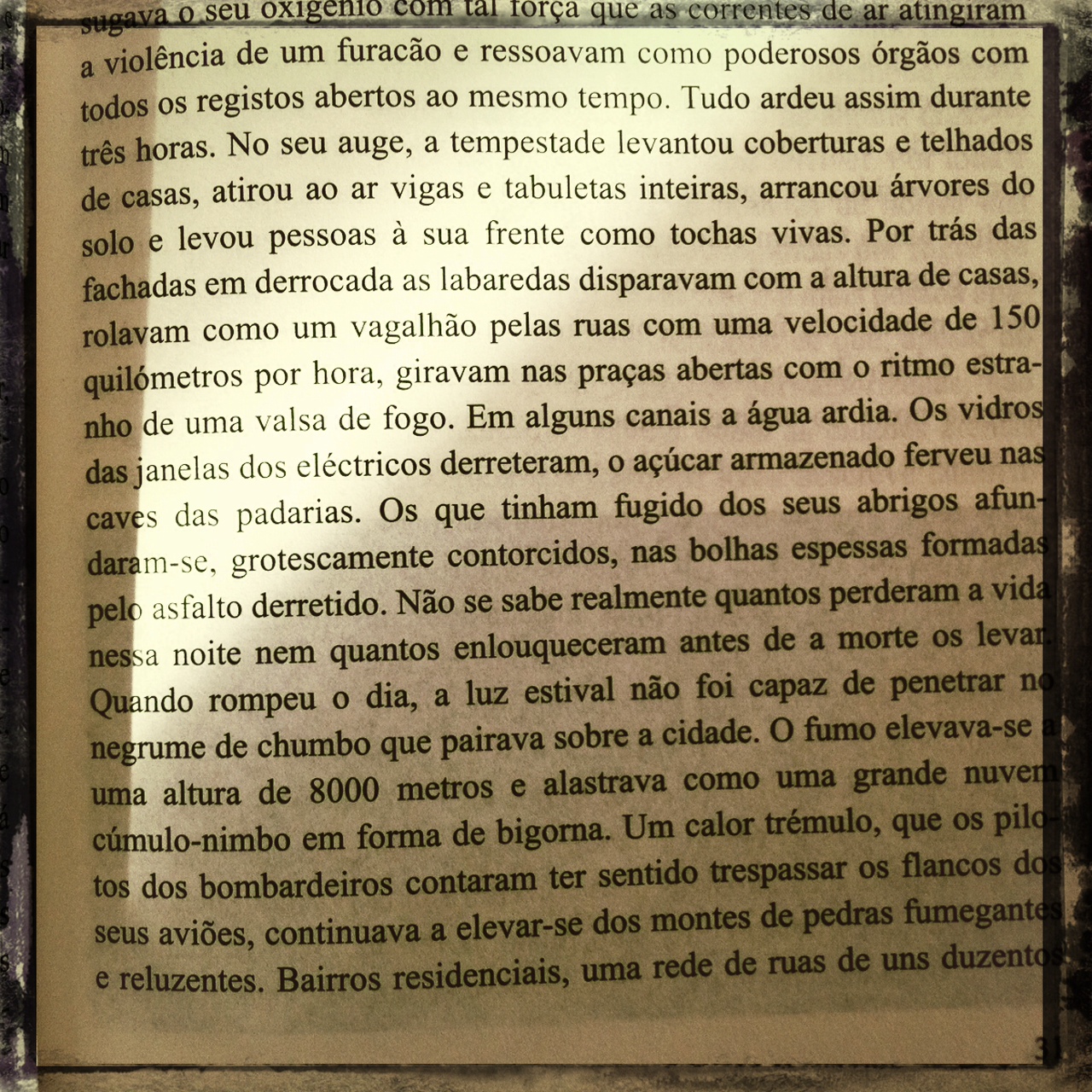

usar frases estereotipadas, contra a memória, quando esta é demasiado dolorosa, ou de dimensão inapreensível. a língua como defesa, esconderijo.
não sei se será totalmente assim. muitas vezes, na alegria, recorre-se a frases ditas mil vezes, e com lucro também - a Hallmark que há décadas se dedica a criar os sentimentos alheios. não sei se a confusão interior limita a expressão ou a cala, quase tentação de negar o sentimento. três pessoas em momento de enorme felicidade, as três com diferentes graus de capacidade linguística e serão três relatos tão diferentes. o primeiro linear, curto e de frases aprendidas; o último detalhado, adjectivado, cronológico. e o sentimento inicial, foi diferente? aqui divago.
"A realidade da destruição total, incompreensível na sua extrema contingência, dilui-se em fórmulas enredadas (...)"
na História Natural da Destruição de Sebald.
de todas, esta: "Sentir como uma perda irreparável o acabar de cada dia. Provavelmente é isto a velhice". embora julgue que isto é a convivência com a morte, que alguns têm mais cedo.
(há quem lhe chame dar graças, mas esses pertencem a outro clube)
(frase salva deste artigo na Visão)
provavelmente na hora de terminar o que me falta.
hoje às 11 na Sic Notícias. (que bom, assim pude chorar à vontade, mas não mais do que o que ri).
a literatura ficou fora do filme que, vê-se, acompanhou Saramago e Pilar com amor e com alguma apreensão. -semelhante à minha sempre que lia sobre outra viagem e outra ainda, onde não há silêncio.
José, porque não foi o Nobel mas um velho debilitado o actor deste filme. mesmo assim, matei algumas saudades.
um conto de Thomas Mann que li entretanto, um dos contos de Death in Venice and Other Stories, que talvez seja desta edição. um personagem real, cujos pensamentos seguimos com leveza, embora se adivinhem os contornos de um final infeliz e pouco heróico. (outra história do desvio) ter férias sem ter trabalhado, ter fim-de-semana sem ter tido semana, comprar sem ter ganho, ser premiado sem ter vencido, chorar sem ter tido alegria, cobiçar sem ter dado, acordar sem ter dormido.
não conheço a moralidade Mann; sei da minha, onde coabitam o bem e o mal com algum estrondo.
dizem que aos moribundos são autorizados raros prazeres que os lembrem da vida. um deles é a imersão em água, em que se demoram por muito tempo, tempo injustificado. pensei neles no mar, pensei neles no ar quente de leite desta noite. a imersão é afinal uma das sensações mais arcaicas, o círculo tem urgência em fechar-se.
a Clelia de La Spiaggia, como esta escrita de Cesare Pavese podia estar em Antonioni (e esteve, mas não esta praia: Tra Donne Sole, onde Clelia foi Eleonora Rossi Drago).
não sei o que acontece nas secretárias, na privacidade dos cubículos, mas é certo que na contracapa alguém proclama esta Praia a mais importante obra do século XX italiano. o próprio chamou-lhe romanzetto e exercício de estilo.
na mesma praia, para ca e para lá na ondulação, corpo de alga e sem qualquer pensamento, não sou eu mas a de treze anos, para quem tudo era possível.
há pouco tempo estive numa paisagem que vejo bem, uma espécie de clareira em terreno acidentado e de mato. em baixo um ribeiro estreito. para lá chegar um caminho de pedras e pó, a descer. vejo claramente a paisagem que li, não lembro onde. perdi-me.
"Her look was black and endless and melting pure. She looked through him. She saw into the troubled thrashing woods of him, a rattling thicket of bones. She saw how he'd woven his own crown of thorns. She saw how although he was not worthy he'd jammed this relief on his brow. Her eyes stared into some hidden place but blocked him out. Flat black." os olhos negros do veado. estar na pele de um alcoólico, entre o trágico e a comédia. em Love Medicine, de Erdrich.
(deer killing scene, aqui em .pdf)
e de novo por S. Momaday, aqui no seu discurso nas Nações Unidas para a 'Cry of the Earth'.
"Sacred places are the truest definitions of the earth; they stand for the earth immediately and forever; they are its flags and its shields. If you would know the earth for what it really is, learn it through its sacred places. At Devil's Tower or Canyon de Chelly or the Cahokia Mounds you touch the pulse of the living planet; you feel its breath upon you. You become one with a spirit that pervades geologic time, that indeed confounds time and space. When I stand on the edge of Monument Valley and behold the great red and blue and purple monoliths floating away in the distance, I have the certain sense that I see beyond time. There the earth lies in eternity."
todo o discurso em ficheiro de som.
ainda a noção de local/earth deJoseph Bruchac, em Native American Stories told by Joseph Bruchac, um autor com vários livros para crianças, um dos quais sou bem capaz de trazer para casa em breve.
"The native people of North America speak of their relationship to the Earth in terms of family. The Earth is not something to be bought and sold, something to be used and mistreated. It is, quite simply, the source of our lives - our Mother. The rest of Creation, all around us, shares in that family relationship." (ou devia)
enquanto ouço Momaday -a sua voz que se impõe e que, imagino, deverá ser impressionante em pessoa, lembro-me das Pequenas Memórias de Saramago. a sua avó, a casa em que passava parte da infância, as árvores, uma das quais se admira (mais de cem anos, parece que ouvi, não duvido que esteja admirada) de estar agora no Campo das Cebolas em Lisboa.
Coyote Tells Why He Sings
There was a little rill of water, near the den,
that showed a trickle, all the dry summer
When I was born. One night in late August, it rained--
The Thunder waked us. Drops came crashing down
In dust, on stiff blackjack leaves, on lichened rocks,
And the rain came in a pelting rush down over the hill;
Wind blew wet into our cave as I heard the sounds
Of leaf-drip, rustling of soggy branches in gusts of wind.
And then the rill's tune changed-- I heard a rock drop
That set new ripples gurgling, in a lower key.
Where the new ripples were, I drank, next morning,
Fresh muddy water that set my teeth on edge.
I thought how delicate that rock's poise was and how
The storm made music when it changed my world.
- -
do livro How the Songs Come Down, em parte disponível aqui, em .pdf.
- -
A SONG THAT WE STILL SING
On the way from Oklahoma up to the Sun Dance
at Crow Dog’s Paradise on the Rosebud Sioux Reservation,
they’d stopped a few minutes,
my Ponca cousins from Oklahoma–
they were way out there by some kind
of ruins, on the August prairie,
some kind of fort it may
have been, they stopped
to eat a little, get out and
stretch their legs, the van
had got too little for
the kids and all.
And they were walking
not paying much attention and they heard
the singing and then Casey said,
Listen, that’s Ponca singing.
Hear it? Where’s it coming from?
They listened, and Mike said,
Sounds like it’s over
inside those walls or whatever
they may be, over there.
So they walked
through the dry short grass
towards the raised earth walls
and up on them, and looked
inside that wide compound, and there
was not a soul in sight.
That was a Wolf Song, Mike said.
Yes, a Victory Song, Casey said.
When they told me later, we looked and
decided that it was where the Cheyennes
and some of their allies had chased some troopers
inside a fort and
taunted them–
after Sand Creek it was,
that time the news got out of what
had been done to Black Kettle and
his people there beneath
that big American flag which they’d been given
in token that this peaceful band
was not to be attacked,
and then at dawn the Reverend Colonel
Chivington and his men attacked and massacred
some hundreds who could not escape–
one small boy, running
for refuge, was shot down at a hundred yards,
because, as Chivington had told his troops,
Nits make lice. The women’s breasts,
sliced off, were made into
tobacco pouches, as were the scrotums
of men. George Bent, a half-Cheyenne who was there,
who’d been a Confederate soldier and
both wrote and spoke English and Cheyenne,
has told about it in his letters–
he saw White Antelope come out
unarmed from his tepee, pointing up
at Old Glory waving over the village there,
then when the troopers kept on shooting,
he stood unmoved and sang, as they shot him down,
the death-song he’d composed for such a time:
Nothing lives long
except the earth and the mountains.
So I asked Casey and Mike,
what do you think you heard, inside that place?
–I guess, Mike said, up in Nebraska
there must have been some Poncas
who joined the Cheyennes there and fought
the soldiers till they chased them
into that fort.
Then Casey said,
We recognized that song. It’s one
that we still sing.
também de Carter Devard, numa viagem passa pelo 'Sand Creek Massacre', que vi há poucos dias em Soldier Blue. a palavra-arte como memória e cura.
num livro de 2004, Native American Literatures:
..."in a Postmodern world that has taught readers to play with the interchange between the meanings of difference and deference on a cultural scale. No telling (signs) can re-present reality (the signified). No human experience can be retold in a story (the words are not the things, events, or people) [aqui vejo o alívio das palavras performativas depois do vazio contínuo do pós-moderno em que andei há uns meses atrás, ou seja, depois de Pynchon ou Barth, é preciso uma cura]. Each human has experiences that are shaped by the various cultures they inhabit; but such habitation is also particular, unique, different. What is more, Postmodern thought is engaged in understanding what constitures a just (ethic) human. The questions generating Postmodern thought might be: how can humans in Western cultures continue to justify violence? And how might a different way of reading lead humankind into nonviolent ways of being in the world?"
um conceito acabado de me chegar, o ecofeminismo ("French feminist Françoise D'Eaubonne is credited with coining the word ecofeminism in 1974. She sought to describe the epic violence inflicted on women and nature as a result of male domination."), que eu teria repudiado com careta há alguns anos. não amo a ideia, mas gosto da prática.
também de Logan, mas mais relacionado com storytelling:
To Light
At the spring
we hear the great seas traveling
underground,
giving themselves up
with tongue of water
that sing the earth open.
They have journeyed through the graveyards
of our loved ones,
turning in their grave
to carry the stories of life to air.
Even the trees with their rings
have kept track
of the crimes that live within
and against us.
We remember it all.
We remember, though we are just skeletons
whose organs and flesh
hold us in.
We have stories
as old as the great seas
breaking through the chest,
flying out the mouth,
noisy tongues that once were silenced,
all the oceans we contain
coming to light.
- - -
parte de uma 'healing ceremony' que dura nove dias. ao nono dia é cantado o Night Chant, em parte repetido em House Made of Dawn, de Scott Momaday, para curar o seu protagonista regressado do Vietname (tal como Tayo de Ceremony).
uma parte, daqui. para ler todo, aqui.
- - -
nisto,
I look at my unhandy hand,
innocent,
shaped as the hands of others are shaped.
Even the pen it holds is a mystery, really.
que deixei ali em baixo.
tantas vezes o que é mais simples...
também não deve desajudar o conhecimento que Hirshfield tem da cultura japonesa.


